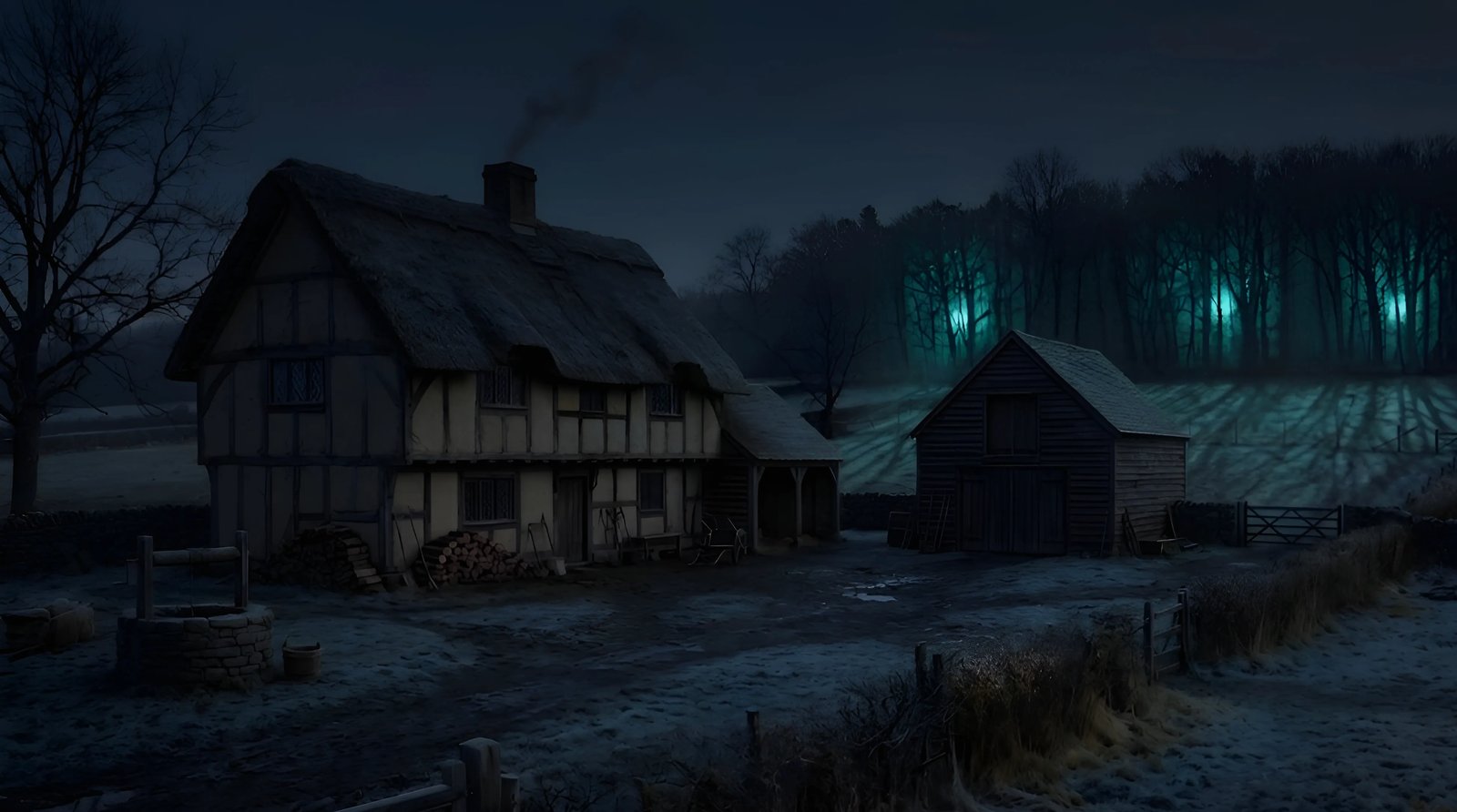
The Good Folk
The Barring
Content note
Child endangerment and animal death.
The morning came in clear and very cold. Frost on every surface, the yard white with it, the fence posts wearing it like sleeves. Edmund was at the byre before first light, moving through the work the way he always did, his hands remembering what to do while his mind turned over the night behind him. He had slept poorly. The door had held. The iron was where he had placed it. Nothing in the house had been disturbed.
He told himself these things as he worked. They were true. They were not enough.
Alice’s voice reached him from the house. Not a scream. Something worse than a scream, his name spoken once with everything ordinary taken out of it. He set down the pail and crossed the yard at a pace that was not yet running.
She was in the doorway. Her hands were at her sides, very still, and her face was the face of a woman who has looked in every room.
“Bess is gone,” she said.
Edmund went through the house himself because he was a man who trusted his own eyes above all others. The bed was empty, the blanket pushed back. Bess’s shoes were by the hearth where Alice set them every night. He looked at the shoes. He looked at the door. He looked at the yard beyond it, white and unbroken in the early light. No small footprints in the frost. None at the threshold, none on the path, none anywhere between the house and the gate. A child of six in a nightdress with bare feet had left this house and the ground had kept no record of it.
He went through the outbuildings one by one, the byre, the barn, the store, calling her name in the voice he used for calling her in from the yard at supper, steady and without alarm, because if she was hiding he did not want her to think she was in trouble and if she was not hiding he did not want to hear what his own voice sounded like when it broke.
She was not in the outbuildings.
He came back to the yard. Alice was where he had left her. Will was coming down from the upper field, drawn by something he had heard or sensed, the way children know when the shape of a morning has changed.
“She is not in the house,” Edmund said. “Not in the barn, not in the byre. Go down to the lower field and along the boundary toward the wood. Call if you find her.”
Will looked at his father’s face and did not ask questions. He turned and went.
The wood. Will felt the weight of that word as he crossed the yard and took the track down toward the lower pasture. The wood where the marks had been, the tracks that came from the trees and stopped at the boundary and did not go back. The wood where the cow had stood at the fence staring into the dark. He had not been afraid of it before this week. It had been a wood, the eastern edge of his father’s land, the place where he had played as a boy and set snares and known every path. He was afraid of it now. He felt that fear in his legs as he came down the slope toward the treeline, a heaviness, the ground pulling at him, and he kept walking because his sister was somewhere in this cold and she was six years old and barefoot and his father had told him to go.
The frost was unbroken everywhere he looked. No small footprints in the white. No track of any kind leading from the house to the fields, which was a thing he noticed and set aside because there was no room for it yet.
He saw the circle first.
It stopped him the way a wall stops a man. Fifteen feet across, cut into the frost at the place where the lower field met the boundary of the wood. The grass inside was flat, pressed against the earth in a single direction. The frost around it was untouched. The frost within was gone, the ground dry, the grass dark green against all that white. He could feel the warmth of it from where he stood, rising off the earth like the memory of summer.
Bess was sitting in the centre of it.
She was in her nightdress, her feet bare, her legs folded beneath her. Her hands were in her lap, open, palms upward, the way their mother sat sometimes by the fire after the children were meant to be asleep, quiet and still and attending to something that was not in the room. Her face was turned toward the treeline. She was very still.
Will said her name.
She did not turn.
He said it again, louder, and crossed the line of frost into the warmth of the ring. The ground under his boots was dry and soft as though it had been a different season inside the circle. He knelt in front of her and put his hands on her shoulders and said her name a third time with his face close to hers.
She blinked. Her eyes found him slowly, travelling back from a great distance, and for a moment Will was looking at a face he did not recognise. Not frightened. Not confused. Absent, the way the calf had been absent in the loft, the way the cow had been absent at the fence. Elsewhere. Then something shifted behind her eyes, some small thing returning, and she was Bess again, blinking at him in the morning light, and she smiled.
“I was waiting,” she said.
“For what?”
She looked at him as though the answer were obvious and he were very slow for not knowing it.
“For them to come back,” she said.
Will picked her up. She was warm against him despite the frost and the nightdress and the October air, warm the way the ground inside the ring was warm, and that wrongness sat against his ribs where he held her. He stood in the centre of the circle with his sister in his arms and shouted for his father.
Edmund was on the track between the outbuildings and the lower field when he heard Will call. He came at a run, the heavy stride breaking through the frost, and Will watched him come across the pasture in a line as direct as a man crossing a battlefield, looking at Bess.
He stopped at the edge of the ring.
Will watched his father see it. Watched him do what he always did, the accounting, the soldier’s inventory of what was in front of him before he allowed himself to feel it. The circle. The frost. The warm dry ground. The precise border between one and the other. Edmund stepped into the ring, knelt the way Will had knelt, put his hand flat against the earth, held it there. His face did not change. Something behind his face changed.
He stood. He looked at the treeline, close here, the first trunks no more than thirty yards from where they stood. He looked at Bess in Will’s arms, her face against Will’s neck, her bare feet hanging, her eyes open and calm and watching the wood over Will’s shoulder with an expression that was not fear.
“There are no footprints,” Will said, because someone had to say it. “Between the house and here. None at all.”
Edmund looked at his son. Will saw his father reach for an answer and find the place where answers had been and find it empty.
“Bring her inside,” Edmund said.
They walked back across the field together, Will carrying Bess, Edmund beside them, his body between his children and the treeline without any sign that he had chosen to place it there. At the gate Alice was waiting. She took Bess from Will’s arms and held her the way you hold a thing you have almost lost, too tightly, her face pressed into the child’s hair, her eyes closed.
“She was in the lower field,” Edmund said. “At the edge of the wood. There is a ring in the ground. The frost cleared in a perfect circle. She was sitting in the middle of it.”
Alice opened her eyes. She looked at Edmund over Bess’s head and in her face was something that was not surprise.
“It is the Good Folk,” she said. Her voice was steady and certain in a way Edmund had not heard before, or had not listened to before. “My mother knew the signs. The ring, the animals, the child taken from her bed. They have marked her, Edmund.”
“Do not call them that.”
The words came out harder than he intended. Alice looked at him, Bess still against her shoulder, and waited the way she waited when he was wrong and knew it and needed time to find his way to knowing it.
“There are no Good Folk,” he said. “There is God. There is the Enemy. What is in that field is not from God.”
“Then we agree on that much,” Alice said quietly.
Edmund looked at her. She looked back at him with seventeen years of patience and something older than patience behind it, the knowledge her mother had given her, the knowledge her mother’s mother had given before that, passed down through women who had never read Scripture and had never needed to because they had their own accounting of the world and it was longer than his.
“Call it what you will,” she said. “Call it the Devil’s work. Call it demons. I will not argue with you about the name. The name does not matter. What matters is that they have been here three nights running and each night they have come closer. They have had her, Edmund. They have had her in their ring and she went to them willingly and she does not remember how.”
Edmund said nothing for a time. The hammer was still in his hand from the work he had been doing that morning. He looked at it.
“What does your mother’s knowledge say to do?” he said. It was not surrender. It was a soldier accepting intelligence from a source he did not fully trust because the alternative was no intelligence at all.
“Iron at every door and window. Rowan where I can place it. Salt at the thresholds. We do not let her out of our sight. We do not open a door after dark for any reason, for any voice, for anything we see or hear.”
“And prayer,” Edmund said. “Scripture read aloud in every room. The Lord’s house will not be taken by the Enemy while His word is spoken in it.”
Alice looked at him. Something passed between them that was not agreement and was not disagreement. It was the recognition that they were building the same wall from different stone and the wall was what mattered.
“Yes,” she said. “And prayer.”
Edmund turned to the door frame. He set the first nail against the wood, the iron cold in his fingers, and drove it home. The sound of it rang through the house like a bell struck once in an empty church.
Behind him Alice went to the shelf where she kept her mother’s things.
The barring took the rest of the morning. Edmund worked the ground floor, every door frame, every window, driving nails into the wood at the height a man would reach and the height a child would reach and the height of nothing he could name. Will worked beside him, holding the nails, fetching the hammer when Edmund set it down, saying little. Upstairs Alice moved through the rooms with her own materials, the rowan branches cut and stripped, the salt in a bowl she carried from threshold to threshold, her lips moving around words Will could not hear and did not ask about.
Bess sat by the hearth and watched them all.
“Why are you putting nails in the door?” she said.
Alice answered before Edmund could. “To keep us safe, sweeting.”
“Safe from what?”
“From the cold,” Alice said, and her voice was so steady and so ordinary that Will almost believed it himself.
Bess accepted this the way children accept things that are obviously untrue when the truth behind them is too large to hold. She pulled her knees up and watched the fire and said nothing more, and her silence was worse than her questions because it meant she had her own answers and was keeping them.
Edmund read Scripture in every room. He stood in the doorway of each and read aloud, a chapter, sometimes only a passage, his voice filling the space the way his voice had always filled a room, with a certainty that did not invite question. Will followed him and listened and said the responses where responses were called for and tried to feel what his father seemed to feel when the words came, the weight of them, the authority. He could not find it. The words were his father’s words, familiar and distant, and behind them the house was full of iron and rowan and salt and the smell of things being done that had no place in the Scripture his father was reading.
By afternoon the house was sealed. Every door, every window, every gap where the air came through. The iron was set. The rowan was placed. The salt lay in thin lines across every threshold like the first frost of a season that had not yet come. Edmund checked it all twice, walking the house the way he walked a position before nightfall, testing every point, looking for the weakness he had not yet found.
The light was failing when he came to stand beside Will at the barn-side shutter. This was the weak point. Edmund had identified it that morning, the shutter that did not sit flush, the frame that had warped in the autumn damp. He had driven four nails into it and packed the gap with rags soaked in salt water and it was still the weak point and they both knew it.
“You will stay at this shutter,” Edmund said. “You will not leave it. You will not open it. Whatever you hear, whatever you think you see. Do you understand?”
“Yes sir.”
They stood together in the fading light, father and son, looking at the shutter that did not sit flush.
“Father,” Will said.
“Yes.”
“Mother’s things. The rowan. The salt. Do you believe in it?”
Edmund was quiet for a time. Outside the light was leaving the fields the way October light leaves, slowly and then all at once, the colour draining from the hedgerows and the fence line and the long pale grass until everything was the same grey.
“Your mother believes what her mother taught her,” Edmund said. “Her mother was a good woman. I did not agree with her in life. I do not speak against her in death.”
“But do you think it works? The rowan, the salt, the words she says?”
Edmund looked at his son. Will could see his father weighing something, deciding how much to give a boy who was not yet a man and who was about to be asked to hold a shutter against the dark.
“I think your mother does what she must,” Edmund said. “I think there is no harm in it. I think the iron is sound and the doors are strong and the Lord hears prayer. I think these things are true. If your mother’s things bring her comfort, I will not take that from her. She has little enough comfort tonight.”
Will nodded. It was not the answer he had wanted. It was the answer his father had, and Edmund had never given him more than he had, and Will had learned not to ask for what was not there.
“And if the iron and the prayers are not enough?” Will said.
Edmund put his hand on Will’s shoulder. The same gesture from the barn, brief, the most he knew how to give.
“Then we hold the position,” he said. “The way I held positions in the war. You do not leave your post. You do not open the shutter. You hold until morning. That is all there is. Hold until morning.”
Will said nothing. He put his hand on the iron nail in the shutter frame and felt the cold of it and tried to feel safe. Outside the last of the light was going.
The last of the light went out of the sky like water leaving a bowl.
Edmund was at the front window, the one that faced the yard and the gate and the track beyond it. Alice was beside the fire with Bess in her lap. The child had not slept since the morning, had not asked to, had sat quiet and watchful through the long afternoon while the house was made ready around her. She was awake now in the firelight, her eyes open, her thumb in her mouth, which she had not done since she was four.
Will was at his shutter.
The house was very quiet. The fire spoke. The wind moved against the walls in the way October wind moved, low and steady, carrying nothing. Edmund stood at the window and watched the dark and listened to the nothing and waited.
It was Will who saw them first.
Through the gap in the shutter, the gap that four nails and salt-soaked rags had narrowed to a sliver, a line of light no wider than a blade. He had been watching the dark through this sliver for a long time, long enough that his eyes had found their way into the night and could read the shapes of the outbuildings, the fence line, the near edge of the lower field. Beyond the field the wood was a darkness inside the darkness, a thing without shape.
The lights began in the wood.
Not suddenly. That was the worst of it. Will could not say when they started because they did not start. They became. One moment the wood was dark. The next there was a light between the trunks, pale, the colour of moonlight where there was no moon. He watched it and told himself it was nothing, a trick of the eye, the kind of phantom the dark made when you stared too long. Then there was another, deeper in the trees, and another, and what he had told himself was nothing was something and it was moving.
“Father,” he said.
Edmund crossed the room without hurrying. He put his eye to the sliver beside Will’s and was still for a long time.
“How many?” he said.
“I cannot tell. Three. Perhaps more.”
The lights drifted between the trunks the way no natural light drifted, without flicker, without the unsteadiness of flame. They moved in and out of the trees with a slowness that seemed deliberate, as though whatever carried them was walking at a pace meant to be observed. Will thought of lanterns and dismissed it. He thought of marsh gas and dismissed it. The lights were too steady, too purposeful, too clearly aware of the house at the edge of the field.
“Alice,” Edmund said. He did not turn from the shutter.
She was already standing. She had set Bess down by the hearth, gently, the way you set down something made of glass. She came to the window and looked out into the yard and Will saw her go very still.
“They are in the wood,” she said.
“Yes.”
“How many?”
“I do not know.”
Alice stood at the window. Edmund stood at the shutter. Will stood between them, watching the lights move through the trees at the bottom of his father’s land, and the three of them were quiet in the way a house is quiet when the people inside it have stopped pretending.
“They will come to the edge of the field,” Alice said. “They will not cross the boundary yet. They are showing themselves. They want us to know they are here.”
Edmund said nothing. Will looked at his father’s face in the dim light and saw something he had never seen there, or had never been old enough to read. His father was afraid. Not the way Will was afraid, the raw unsteady fear of a boy. This was the fear of a man who had been afraid before and knew what it cost and was preparing to pay it.
Edmund stepped back from the shutter. He looked at Will.
“Do not leave your post,” he said. “Watch them. Tell me if they come closer. Tell me if they leave the trees.”
He went to the table where he had laid the Bible that afternoon, open to a passage he had chosen with care. He picked it up and began to read aloud. His voice filled the room the way it filled the room every evening, steady, certain, the voice of a man who had always believed that the word of God was a wall no enemy could breach.
Will turned back to his sliver of darkness.
The lights had come to the edge of the wood. They hung there between the last trunks, five of them now, six, pale and steady and patient. They did not move into the field. Alice had been right. They were showing themselves. They were letting the family know that the night had changed and would not change back.
Will watched them. His hand found the iron nail nearest to him in the shutter frame and held it, the cold of the metal sharp against his palm. Behind him his father’s voice moved through Scripture like a river over stones, familiar and unceasing. Beside the fire Bess sat with her knees drawn up, her eyes very wide, looking not at the shutter and not at her father and not at the fire.
Looking at the door.
Will saw it from the corner of his eye and the cold went through him in a way that had nothing to do with October.
She was looking at the door the way she had been looking at the treeline that morning. Open, calm, patient. The face of a child who has been told that someone is coming and is content to wait.
The first sound came from outside. Not music. Not yet. Something beneath music, a vibration more felt than heard, as though the air itself had begun to hum at a frequency the body understood before the ear. Will felt it in his chest, in his teeth, in the place behind his eyes. He gripped the nail tighter.
In the far field the lights began to move.
Next in The Good Folk
The SiegeClick either side of the page, or use ← →