The Sisters Swan and the Cats Three
Content note
Historical violence, blood, and death.
Being a true and faithful account of Rebecca Swan, sometime letter-writer of this parish, and of her sister Eliza, and of the particulars of their lives and deaths, as they were told in the town of Kidderminster in the years that followed — and as they were not told.
There were three cats, and that is where I shall begin, because the cats are the thing all accounts agree upon.
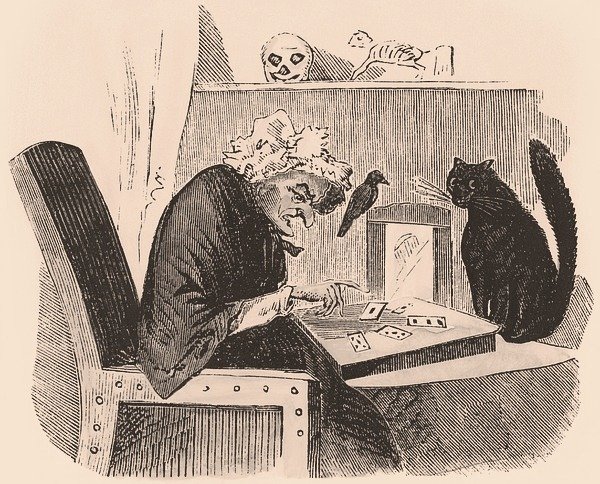
Queen of Sheba was the largest and the blackest. Queen Caroline was the colour of a bruised apple and had a tear in her left ear from some quarrel long past. Princess Charlotte was a small white creature, one eye blue and one yellow, and my mother held it that the Princess was the oldest of the three and had come to Rebecca as a kitten when Becky was still a young woman in the weavers’ lanes, before any of what follows. That cannot be true, for cats do not live so long. But I set it down because my mother believed it, and she was not a foolish woman in any other matter.
The cats were always in the room when Becky gave audience. They would leap upon her shoulders and purr in her ear, and she would nod as though listening, and then she would tell you what they had said. The voice that came out of her in those moments was her own voice, but slower, and with a little pause between each word, as if the words were being handed to her one at a time from somewhere she could not quite see. I heard it once. I shall not pretend otherwise. I had not gone for my own business but in company with another, and I paid no shilling, and what she said was not said to me. But I heard it, and I remember the pause.
She was past seventy by then, and she lived in a cottage at the top of Station Hill, where it meets the Worcester Road. You would know the place still, if it were still there. It is not. The slums came down in my father’s time, and what stands on the ground now is a wall and a road and the wind comes up the hill the same as it ever did, but there is no cottage for it to rattle against. The cottage leaned toward the Stour like a thing listening for something. The door was painted a black that had long since gone to grey, and over it was nailed a great sign, in letters bigger than the door itself, which read:
Rebecca Swan, town and county letter writer to all parts, gives advise in all periods. No need to apply without recommendation. I have been wrongfully used. Wishes to do justice, love mercy, and walk humbly with God.
I remember that sign particular, because of the word advise spelt the wrong way, and because of the phrase I have been wrongfully used, which is not the sort of phrase you nail above a door unless you mean it to be read. It was read. The whole town read it. Some laughed and some crossed themselves, and some went in, and some of those who went in came out shaking.
She called herself a letter writer. That was her trade in the town register, and she could indeed write a letter, for a small fee, to any part of the country or abroad, and her hand was a clear round hand and her spelling was only fair. But nobody in the town was under any illusion that letters were the chief of her business.
To understand Rebecca you must first understand her sister, and to understand Eliza you must understand what the town was like in the years when the two of them were young.
Kidderminster was a carpet town then, and it is a carpet town still, though the looms are mostly quiet now and the river is cleaner than it was and the smell of the dye houses is gone. In the years when Eliza was weaving it was not so. The Stour ran with colour. The air above the looms shops was full of lint and the clack of the shuttle went on through the night in every street from the church down to the Horsefair, and no one who lived here can have slept without it. A weaver worked to fall-day, which was Thursday or Saturday, and on fall-day the twenty-five yard piece had to be carried in to the master for inspection and payment, and that was how the week turned, and the market with it. A weaver who missed fall-day missed his week. A weaver who missed two fall-days was hungry. A weaver who missed three was in trouble with the rent.
Eliza Swan was a hand weaver, and she worked in her own cottage, not in a factory, for in those days it was still possible for a woman with a loom and a room to take piece-work home and return it on fall-day. She was, by all accounts, a quiet woman. She kept a diary, which I have seen portions of, for portions of it came down through a family in Mill Street and were shown to me once by a cousin of that family at the back of the Lion. It was a small brown book, foxed at the edges, and the hand in it was not the hand I should have expected of a weaver, being finer and more cramped than Becky’s was. The diary ran from the year ‘97 to the year ‘21, which is to say from before my birth to about the time I first remember anything, and it is full of three kinds of things. It is full of the weather. It is full of dreams. And it is full of charms.
Of the charms I remember one above all, because my mother used it, and I had it used on me, and I can write it down now without reference to any book.
Christ was born in Bethlehem, and was christened in the River Jordon. In the waters stand and say: Command this blood, in the name of the Father. Stay blood, in the name of the Holy Ghost. Stay blood.
And every time you say the word blood, you must say the name of the person bleeding.
I had my hand cut when I was nine, on a piece of iron that was lying in the yard of the Black Horse, and my mother took me up the hill to Eliza Swan, for my mother had known Eliza since girlhood and would trust no other for the stopping of blood. Eliza was not old then — she could not have been more than fifty — but she seemed old to me because she was thin and because her hair was already grey and because her cottage smelt of damp wool and because she did not speak to me, only took my hand in her own hand, which was dry and rough as the back of a file, and said the charm over it, saying my name where the word blood came, and the blood stopped. I do not pretend to explain this. I set it down. The blood stopped, and she tied a strip of linen round my hand and gave my mother a small piece of bread and did not ask for any money, and we went home.
That was the only time I met Eliza in her own house. I saw her once more, at a distance, years later, and I shall come to that.
Her diary, in the parts I was shown, is full of small things. She dreams of a white horse three nights running and puts down what she thinks it means. She copies out a charm for the toothache she has had from an old woman in Stourport. She notes that her loom broke a warp thread on a Tuesday and that the yarn agent called on Monday as he always did. She notes that she has no money for coals. She notes that she has no money for meat. She notes, in one place, that she has been taken for debt and sent to the county gaol at Worcester for a period she does not specify, and when the diary resumes it is resumed as if nothing had interrupted it, only now she is back at the loom and the warp is giving her trouble again.
She was often in great poverty, was Eliza. The parish was harder on a woman weaver than on a man, and when the prices fell, as they did in the year ‘28 when the masters cut the rate for Brussels carpet and the weavers came out and the strike went on for twenty-one weeks and half the town was starving by the end of it, it was women like Eliza who went under first. By then her diary had stopped. I do not know why it stopped in the year ‘21 and not later. Perhaps she could no longer afford ink. Perhaps the book was full. Perhaps she wrote a second book and it was lost. The piece I saw was the first book.
She died in the year ‘34, of a fever, in her own cottage, alone. Becky was with her at the last, so it was said, though Becky was the only one who said so, and Becky was not always a reliable witness in her own cause.
Becky was three years younger than her sister, and she was not a weaver.
What Becky did in her early life is not clear. She had been in service, that much is certain, for she spoke sometimes of a household in Bewdley where she had been a maid, and she had a way of handling a tea-cup that no weaver’s sister learned at her own hearth. She had been married, also, though her husband was long gone by the time I first remember her, and whether he was dead or only departed was one of the things the town did not settle. She had no children that anyone knew of. She had, at various times, lodgings in various parts of the town, and she was not always respectable in them, and she was once bound over for keeping a disorderly house in Mill Street, but that was a long time before the business with the magistrate, and by the time she moved to Station Hill she was past fifty and she had, so she said, reformed.
What she had reformed into was the sign above the door.
She had learned the charms from Eliza. That was always understood, and Becky never denied it, though she put it differently. I had them from my sister, who had them from our mother, who had them from her mother, who had them from an old woman in Wribbenhall who was burnt. The last part was, I believe, embellishment. No one in living memory had been burnt in Wribbenhall or anywhere else in the county. But Becky told it so, and she told it often, and there were those who came to believe it, and that was the sort of telling Becky was good at. Eliza’s charms were, in Becky’s mouth, older and darker than they had been in Eliza’s. Eliza had said Stay blood in the name of the Father*. Becky said *Stay blood, stay the breath, stay the heart, in the name of the Father and of what was before the Father. Which is not a thing a Christian woman says, and was not the charm her sister had written down, but Becky’s clients were not the sort to know the difference, and Becky was not the sort to care.
The business with the magistrate was in the year ‘43 or thereabouts, and it made her.
She had taken seven shillings from a servant girl in Hartlebury, a girl of sixteen who wished to know whether the young man she was walking out with was true to her. Becky had told her, for the seven shillings, that he was not, and that he would prove false within the quarter, and that there was a way — there was always a way, with Becky — of binding him, which would require another five shillings and the girl’s own hair, and the hair of the young man, which the girl would have to obtain. The girl had obtained the hair. The girl had paid the five shillings. The binding had been performed in Becky’s cottage, with the cats purring, and the girl had gone home, and the young man had within the month married another, and the girl had gone to her master in tears and her master had gone to the magistrate.
The magistrate was a Mr. Talbot of Hoo Farm, a gentleman of the town, well liked, in good health, not above sixty. He heard the case and he found Becky guilty of obtaining money by false pretences, and he sentenced her to three months in the county gaol at Worcester. And as they were leading her from the dock, Becky turned to him, in front of the whole court, and she said — and here I am taking the words as they were reported to me by a man who was in the court that day, an attorney’s clerk, a sober man not given to invention — she said:
Sir, you will not live to see me come out of this place.
She said it quiet, not loud, and she said it without looking at him but at a point a little above his head, as though she were reading something written there. And then she was taken out, and the court moved on to the next case.
Mr. Talbot died on the eleventh day of her imprisonment. He had been in perfect health at breakfast. He was found at his desk after dinner, his face pressed to the blotter, a pen still in his fingers, and the doctor said his heart had simply stopped. There was no cause in it. He had been a temperate man.
That was all the town needed.
When Becky came out of the gaol at the end of her three months, she came back to Kidderminster to find the sign already half-painted by a boy in Horsefair who had been paid to do it by persons unknown, and she came back to find a queue at her door, and she came back to find that the cottage on Station Hill — which had been standing empty, the previous tenant having died of a flux — was hers if she wanted it, the rent being paid for the first quarter by a widow who wished to know something about a will. Becky took it. She hung the sign. She bought the cats, or the cats came to her, or the cats had always been there, depending on which account you heard. And she commenced in her profession.
Queen of Sheba would sit on the left shoulder. Queen Caroline on the right. Princess Charlotte on her lap, or walking the table, or watching from the mantelshelf. They were royal names for a woman who was not royal and would never be, and I think now that was part of the point — Becky had a taste for putting things above her station in the wrong places. Her cottage was a slum cottage. Her cats were queens. Her sign above the door was the size of a shop-sign and it spoke of God.
She gave her audiences in the front room, which was small, and which in the winter was heated by a single fire, and which in any season was dark because she kept the shutter half-closed. The walls, so those who went in reported, were hung with dried things. A stuffed owl, mounted very ill by some amateur hand, sat on a bracket above the hearth. Snake-skins were pinned to the beam, which was a thing she had got from somewhere and which I cannot account for, for there are no snakes in Kidderminster large enough to provide such a skin, and whoever had sold them to Becky had had them from further off. There were bat wings in a jar on the mantel. There was a dish of salt by the door, which she renewed on Sundays. And there was the chair — her chair, the tall one with the rush seat, in which she sat with the cats, and across from which a single stool was placed for whoever had come to see her.
She would ask the client their business. She would listen, her eyes half-shut. She would nod. And then a cat — usually Sheba, who was the theatrical one — would leap to her shoulder, and Becky would tilt her head to listen, and she would say: Sheba says he is still alive. Or: Sheba says the ring is in the river near the bridge. Or: Sheba says your mother forgives you for what you did, but your sister does not, and will not, and you must live with that. She had a gift, whatever else she had, for saying the hard thing when the hard thing was what the client had come hoping not to hear.
She was most famous for the recovery of lost property. This was her speciality, and it was, I am nearly certain, a trade. Becky knew everyone in the town who moved, and she knew a good many who moved beyond the town — the bargees on the canal, the higglers on the road to Stourport, the gypsies on Hartlebury Common — and word came to her, and word went from her, and property that had been lost was, with surprising frequency, restored. I remember the Carter family’s donkey, which was lost out of its paddock in the summer of ‘47, and the youngest Carter girl was sent up the hill with sixpence to ask Becky where it was. Becky consulted Sheba. Sheba was of the opinion that the donkey would be back by the following afternoon. And the following afternoon a gypsy came down from Hartlebury Common with the donkey on a rope, saying he had found it straying, and had asked about, and had learnt who was missing a donkey, and had brought it back out of the goodness of his heart, and hoped the young ladies would consider his trouble and the loss of his time. The young ladies considered it. The gypsy was given half a crown and a loaf. Not a word was spoken of Becky. But everybody concerned knew who was responsible, and Becky’s name stood the higher for it, and sixpence had gone up the hill, and I should be surprised if sixpence did not find its way back down again in due course, by some route that passed through Hartlebury Common.
She could not, however, find her own lost things. This was remarked upon. She lost twelve half-crowns once, and several gold rings, and her art did not assist her in their recovery. She was robbed, in short, by somebody she knew, and the cats were silent on the matter, and Becky went without the money and said nothing more of it, and those of us who observed this drew our own conclusions, and did not state them.
She drank.
This was the other thing about Becky, and it was the thing which, in the end, undid her. She was very fond of gin, and she kept a stone bottle of it under her chair, and she drank from it during her audiences, not openly but at intervals, and she drank far more of it when her audiences were over and the cottage was empty and the cats were fed and the fire was down to embers. On those nights, which were most nights, she would sit in her chair and she would talk. Not to the cats, though the cats were there. To something else. To something in the room that nobody could see, or to something beyond the room, or to her own self in a voice that was not her own self, or to her sister — for there were those who passed her window on the Station Hill side and heard, through the shutter, the word Eliza, and more than once.
She claimed she was in conference with the invisible world. She said that she wrestled on those nights with witches and with devils. And certainly she would appear, in the morning, with scratches on her face and bruises on her arms that she said she had got from those contests. Her clients, when they came in the afternoon, were made to look upon these marks, and were told: I have been in struggle for you. I have wrestled with them for you. And most of them believed her.
I did not believe her. But my mother, who was a plain woman, said to me once, when I scoffed at it: she is scratched by something, child. She lives alone. Who is scratching her?
I had no answer then. I have no better answer now.
I said that I saw Eliza once more, at a distance, years after she had died.
It was in the autumn of the year ‘49, and I was walking up Station Hill in the evening with a parcel I had been asked to deliver to a house on Worcester Road, and it was already dusk, and there was a little mist off the river. I was passing Becky’s cottage. The shutter was not quite closed. I glanced in, as anyone would, and I saw Becky in her chair, asleep or pretending to be asleep, and the three cats about her, and opposite her, on the stool where the clients sat, there was a woman.
The woman was thin. Her hair was grey. Her hands were folded in her lap and her hands were dry and rough, though I could not have seen that from where I stood, and I do not pretend that I saw it, only that I knew it, and it was the knowing that stopped me.
I looked again. The woman was still there. She was looking at Becky the way a mother looks at a child who has done something foolish but not yet unforgivable. She was not speaking. Becky was not speaking. The cats were not moving.
I went on up the hill and delivered my parcel. When I came back down, not ten minutes later, the shutter was closed. I did not look in.
I told my mother, when I got home. My mother said nothing for a long time. Then she said: Eliza loved her sister. Whatever Becky has become, Eliza loved her. It is not strange that she should come back.
I said: But Eliza is dead these fifteen years.
My mother said: Yes. And Becky is drunk most nights, and she lives alone, and who do you suppose she is talking to?
She died in the November of the year ‘50, on a Thursday, which was a fall-day, and the market was busy when the word went out.
She had been drinking, heavily, the night before. She had been, by all accounts, more saturated with gin than was usual even for her, and that was saying a great deal. She had sat in her chair by the fire, as she always did, and she had been in conference with whatever it was she conferred with, and at some point in the night — the coroner could not say when, and nor could anyone else — she had risen from the chair, perhaps to feed the fire, perhaps to reach for the bottle, perhaps for no reason at all, and she had fallen.
She had fallen into the fire.
The fire had caught her skirts. She had been, by then, too far gone in drink to put it out, or to rise, or perhaps even to know what was happening. She had burnt in her own hearth.
Her neighbours had heard the groans. They had heard them, by their own testimony at the inquest, throughout the small hours of the night. They had not come. They said, when asked, that they had been accustomed to groans from Becky’s cottage, and had considered that she was brewing some potent spell and had forgot the usual precaution, and had not wished to interrupt her. They said this at the inquest and the coroner, who was a Worcester man and no fool, looked at them a long time and wrote it down and did not press them, for what was there to press? A verdict of accidental death was recorded. The inquest was held at the Worcester Cross. The neighbours went home.
I was one of those who saw her buried — her ashes, rather, for there was not a great deal left of her to bury. The crowd was enormous. Half the town came up the hill that day, and it was a cold bright November day, and the leaves were off the trees and the river was low, and the crowd was so great that the constables had to make a way for the bearers. But the remains were not taken into the church. The vicar, a new man, would not have her in, and no one argued with him very hard, and she was buried in the part of the ground where the unconsecrated go, and a small stone was put up later, by subscription, which gave her name and the year.
The cats were not seen again.
This is the thing that closes every telling of the story of Becky Swan, and it closes mine, because I have nothing to set against it. The morning after the fire, when the neighbours at last went in, the cottage was full of smoke and the chair was charred to the springs and Becky was what she was, and the cats were gone. Not dead in the fire — there were no remains of them, and a cat’s bones would have been found. Not in the yard. Not in the street. Not in any of the outbuildings, which were searched, at my own insistence, later that day, by myself and by a boy from the Horsefair, for I had a feeling I could not put down and could not explain.
They were gone.
I walked up Station Hill for a month after that, in the evenings, looking for them. I did not see them. Nobody did. I asked a bargee on the canal whether three cats had been seen going down toward the Stour, and he said no. I asked a carter on the Worcester Road whether three cats had been seen going out of town, and he said no. I asked an old woman in Hartlebury, a month later, whether three cats had been seen going up onto the Common, and she looked at me a long time and she said: child, three cats did not go anywhere. Three cats left when their mistress left. It is the way of such creatures. You are looking in the wrong direction.
I did not ask her what the right direction was.
I did not want to know.
That is the tale as I have it. I have given it as fair as I am able. I have not set down what I do not believe, except where the not believing seemed to me less true than the believing, and even there I have marked where I stood.
I pass the place still, though the cottage is gone and the wall is where the door was and the sign has been fuel for somebody’s fire these seventy years. I pass it in the evenings most often, coming up from the station, and the wind comes the same up the hill as it ever did, and sometimes, when the wind is in the right quarter and there is mist off the river, I fancy I hear a loom, faint, from somewhere behind me, going on into the night as looms used to go on in this town — and I fancy I hear a cat, and I fancy I hear a woman saying a name over a cut, and I know that I am fancying it, and I walk on.
The blood stays where it is told to stay. That is the only part of the charm I am sure of.
Everything else I leave to the reader.
The end
Click either side of the page, or use ← →